 Technical Article
Evaluation of broilers growth fed with diets supplemented with…
Evaluation of broilers growth fed with diets supplemented with Synbiotic compared to Antibiotics

In animal production, antimicrobial resistance of pathogens is threatening animal and human health. This has resulted in the search for natural alternatives which could replace antibiotics as growth promoters and improve animal health, including those which stimulate growth of beneficial bacteria in the gut. The use of prebiotics, probiotics and synbiotics as an alternative to antibiotic growth promoters in poultry feed has been extensively studied. In the present study, the effects of synbiotic supplementation on the growth parameters of broilers were analysed and compared with antibiotic growth promoters commercially available in the market. In addition to growth parameters, intestinal length and morphology of the intestine were also evaluated during this experiment.
Bacflora F is a Synbiotic (Prebiotic + Probiotic) product of XVET Germany and also counts with the acidifying effect of rich organic acids. This balanced synergy of ingredients, helps to enhance gut health and support digestive performance.
For this experiment, six hundred-forty (640) one-day old broiler chickens (Ross 308) which were previously immunized against routine diseases (breed rearing program) were used in this study. The birds were randomly divided into 32 areas (Each treatment: 20 birds) with 4 repetitions for each of the treatments (Table. 1).

The total feed consumption, average weight gain, Feed Conversion Ratio (FCR), intestinal length (day 21 and 49) and intestinal epithelium morphology (day 21 and 42) were evaluated. ANOVA Minitab 16 was utilized to analyse the data where values of P<0.05 were considered statistically significant.
Results:
Total feed consumption, weight gain and FCR:
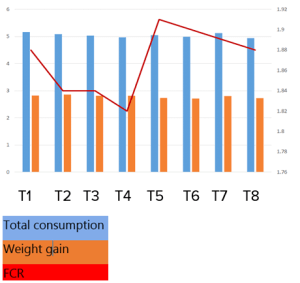
T1 (Antibiotic) had the highest (5.162a ± 0.18) feed consumption (P<0.05) whereas T8 (Control) consumed the smallest quantity of feed (4.937c ± 0.18). Throughout the duration of the experiment, treatment 2 (Antibiotic) had the higher weight gain (2.859a ± 0.18) which was significantly different (P<0.05) from Treatment 6 (Prebiotic). Amongst the groups fed with non-antibiotic growth promoters (NAGPs) such as Bacflora F and other commercially available prebiotics and synbiotics, Bacflora F (T3) group had the highest weight gain (2.817abc ± 0.10) when compared with the (P>0.05) (Figure 1). FCR was significantly lower in T4 (Bacflora F) (1.82 b ± 0.08) (Figure 2). Figure 3 shows the feed consumption, weight gain and FCR in all the treatments.


Figure 3: Comparison between total feed consumption, weight gain and FCR
Intestinal Length:
The longest intestine was observed for group T7 (Synbiotic competitor) at day 21 (128.00 a ± 15.31) with no significant difference with all the other treatments. It is worth to mention that at day 49, Bacflora F treatments had longer intestine in comparison with the Synbiotic competitor treatment (t7).
Intestinal morphology:
At day 21, Treatment 4 (Bacflora F) showed the (Microns) greatest villi height (1794.5a ± 0.18) in the Duodenum, being statistically different (P<0.05) from all other groups in the treatment. The thickest (1920.2a ± 97.82) mucous layer in day 21 in the duodenum was shown in the Treatment 4 (Bacflora F) as well. At this day, Treatment 1 (Antibiotic) had the highest (Microns) value (163.65a ± 20.21) for intestinal crypt depth in the duodenum, being statistically different (P<0.05) from Treatments T3 (119.02bc ± 20.21), T4 (125.66bc ± 20.21) and T5 (107.42c ± 20.21). This is a positive result because small crypts indicate that the Villi are in a good state as they need less replacement of functional cells that arise from the crypts.
At day 42, Treatment 2 (Antibiotics) and Treatment 7 (Synbiotic competitor) showed the lowest values (Microns) for the Villi height (2036.2b± 143.34) and (2063.9b ± 143.34) respectively in the Duodenum (P<0.05). It is worth mentioning that Bacflora F (T4) treatment presented the greatest (1014.09 a ± 143.34) value of Villi height (P<0.05) in the Ileum at this day (42 days). Also, it is demonstrated that Bacfora F treatments (T3, T4) in both the Duodenum and Jejunum had greater mucous thickness in comparison with T7 (Synbiotic competitor). In the Ileum the mucosa thickness (11621.1a± 66.63) for treatment 4 (Bacflora F) was significantly higher compared to all the other treatments.
Conclusion:
Although the poultry supplemented with the Antibiotic in this experiment presented the heaviest final weight of all treatments, the Feed Conversion Ratio was the lowest for the groups supplemented with Bacflora F. This is a very important parameter to be taken into consideration as this means producers would need to give less feed for the poultry to convert it in weight, thus saving money. Therefore, this analysis of cost analysis would determine Bacflora F as the best option.
The proportion between the Villi length and Crypt depth indicates better intestinal health. The thickness of the mucous layer is also important because a mucous layer with the same thickness but with smaller Crypt presents longer Villi and therefore better absorption. It is demonstrated that Bacflora F treatment (T4) at day 21 and 42 presented the highest Villi in the Duodenum and Ileum. T4 also showed the thickest mucous layer in day 21. In the Ileum the mucosa thickness for treatment 4 (Bacflora F) was significantly (P<0.05) higher compared to all the other treatments. The thicker mucosa, represents a more developed intestine, which proposes a better performance, and as well as strong resistance against transient pathogens, or toxic substances produced by them in a natural way.
It is concluded that administering Bacflora F is supporting the gut health and the flock performance as Non Antibiotic Growth Promoter (NAGP).
For more information please contact technical@xvetgermany.com


